Your network can be just infrastructure, or it can be a driver of business outcomes. Most networks are built to pass traffic and keep devices connected. An outcome-ready network is designed to deliver the experiences and efficiencies your enterprise depends on, and that requires a different kind of intent behind how you design, deploy, and configure it.
From Network as Infrastructure to Network as Outcomes
Think about what a traditional network does: it connects devices and delivers bandwidth. But an outcome-ready network turns your infrastructure into a sensing layer that powers real business value.
Every access point, every switch, every connected device becomes part of a system that captures data about how your spaces are actually being used. Occupancy patterns. Indoor navigation. Asset locations. Space utilization. Real-time visibility into the experiences your spaces are delivering and where efficiencies can be gained.
The hardware is the same. The intent is completely different.
The Honest Gap Most Organizations Face
Here’s what we see: Cisco customers already own the infrastructure. They’ve invested. But there’s a gap between having a network and having an outcome-ready network.
A network optimized purely for connectivity won’t reliably capture location data or usage patterns. A Wireless Access Point placement designed to maximize signal strength isn’t the same as one designed to enable accurate asset tracking or indoor navigation. Configuration matters. Density matters. Design matters.
You may already own the hardware. It’s just not set up to deliver the outcomes you need yet.
The Foundational Elements Behind Every Outcome-Ready Network
Three core elements are at play in every outcome-ready network:
- AP Model, Optimal Density, and Placement: The right hardware in the right places, configured intentionally for your outcomes (not just connectivity).
- Network Design Validation: Confirming your design will deliver the outcomes you’ve defined before you deploy.
- OS Configuration and Data Pipeline: The software layer that transforms raw network data into actionable insights and experiences.
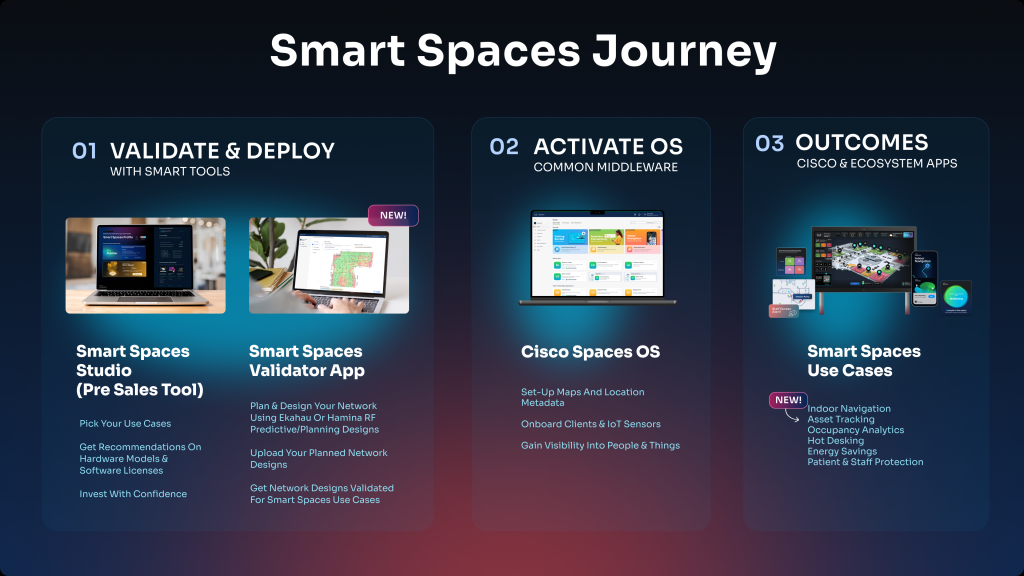
How To Build One: Three Phases to Outcome-Ready Network
You don’t need to do this all at once, and you probably shouldn’t.
Phase 1: Validate & Deploy – Start by defining your outcomes (Occupancy Monitoring, Indoor Navigation, Asset Tracking) and using the Smart Spaces Studio to model your space and design your network accordingly. Wi-Fi, BLE, UWB – different outcomes require different technology choices, and the Studio shows you the tradeoffs.
Next, validate your network design. Use the Smart Spaces Validator to confirm that your Ekahau or Hamina network design files meet the requirements for your intended smart spaces outcomes.
Then deploy with configuration intent. This is about more than turning on APs. It’s about setting them up to generate the data you need to drive your outcomes.
Phase 2: Activate OS – Wire your network to Cisco Spaces. Set up your maps, configure location services, and connect your integrations. Now your raw data becomes the experiences and efficiencies you designed for.
Phase 3: Unlock Outcomes – You now have a live network generating data about how your spaces are actually being used. Once occupancy monitoring is live, asset tracking becomes possible; with floor maps in place and your network generating location data, indoor navigation is ready to activate; once you understand traffic patterns, energy efficiency opportunities emerge.
This isn’t the end of the journey. It’s where the real value unlocks and compounds.
Want to see this in action? We’re walking through a live example at our upcoming Digital Event on May 14, Be Legendary: Create an Outcome Ready Network for Smart Spaces. You’ll see how real organizations are moving from “we have a network” to “our network delivers the outcomes we need.”
Register for the event here. It’s free!