Most people don’t think twice about a captive portal.
You enter a space, connect to the Wi-Fi, type in your email, tap accept, and move on. It’s a speed bump, not an experience. But what if that tiny moment could do a lot more?
In our recent Cisco Spaces Learning Series session on Captive Portals, we unpacked exactly that: how organizations are turning a routine Wi-Fi login into something genuinely useful. For their visitors. And for their business.
First, let’s get people connected. Properly
The basics still matter. Cisco Spaces lets you build branded onboarding experiences that actually feel like your brand, not a generic network page. One-click connect, email, phone, social login, custom forms. You choose what works for your audience.
You can set up separate flows for guests and employees, configure privacy and marketing opt-ins, and see how people are onboarding through built-in reporting.
It’s a small thing, but it’s the first impression your network makes. It should feel intentional.
Now, think about what you know in that moment
When someone joins your Wi-Fi, you know a few things. They’re physically there: in your store, hotel, hospital, campus, or venue. You know when they arrived. You might know if they’ve been before.
That context is more valuable than most organizations realize.
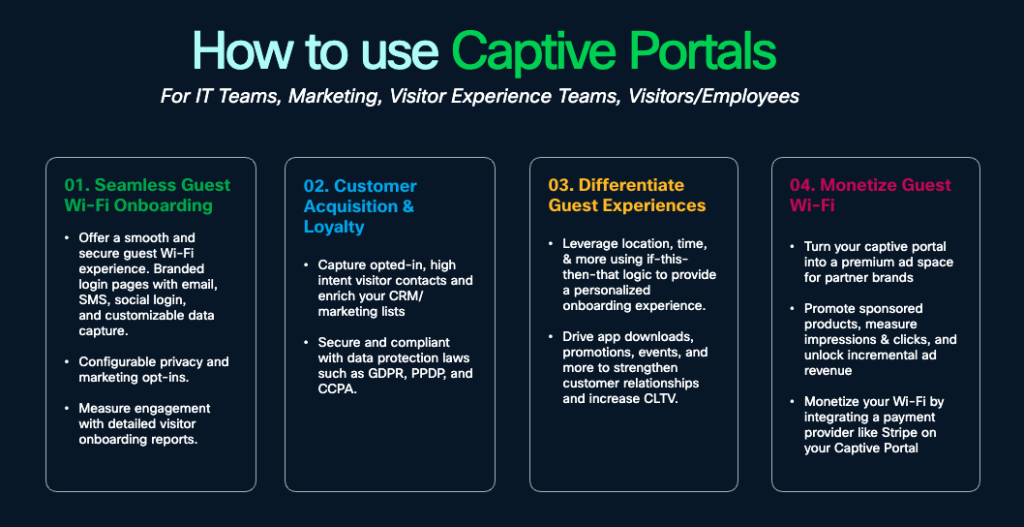
Cisco Spaces Captive Portals let you use it. You can change what people see based on who they are, where they are, how often they visit, and even what time or day it is. A first-time visitor sees something different from a regular. The ground floor shows something different from the executive suite.
A retailer can send out a promotion specific to that store. A venue can spotlight a sponsor or an event experience. A hotel can nudge guests toward an app or a service.
The portal stops being a login screen. It becomes a contextual touchpoint: one that’s actually relevant to the person standing there.
And it can build your audience while it’s at it
Every person who connects through your portal is physically present and engaged enough to opt in. That’s a meaningful signal.
Cisco Spaces lets organizations capture opted-in visitor data through the onboarding journey, feeding directly into CRM and marketing lists. Privacy and consent are fully configurable: GDPR, PDPA, CCPA, so compliance isn’t an afterthought.
The question shifts from “How do I get them connected?” to “They’re here right now! How do I make this count?”
For high-footfall spaces, there’s even a revenue angle
Venues, retail locations, and hospitality environments can take it further. By using the captive portal as advertising real estate for partner brands, promoting sponsored products, and tracking impressions and clicks.
The network that used to just keep people connected can now support something closer to a revenue channel.
You don’t have to build it from scratch
Already have a captive portal designed in CSS? Import it directly. Have a web or marketing team? They can build entirely custom experiences. Need help? The Cisco Spaces design team can work with you.
Logos, fonts, data fields, redirect URLs – it’s all configurable. And the reporting built into the platform means you can actually see how people are interacting with your portal and improve it over time.
One network. A lot more possibilities.
Captive portals are one of the simplest places to see what Cisco Spaces is really about, taking infrastructure you already have and getting meaningfully more out of it.
What starts as a Wi-Fi login can become a smoother onboarding experience, a branded moment, a contextual offer, an opted-in audience, a sponsorship channel, and a source of data you actually use.
So the next time someone connects to your guest Wi-Fi, are you just getting them online, or are you making that connection count?
Are you a Spaces customer, but haven’t explored Captive Portals yet? Check out our Setup Guide and set it up today! Interested in knowing more? Reach out to us here!